

Astrology without an astrologer
If you are not an astrologer and have never studied astrology seriously, then most of what you know about it probably comes from an idea introduced by William Frederick Allan in 1899. That was when his book "Astrology for All" was published, and with it a simple Sun-sign principle became fixed in popular culture: if you were born in May, you are a Taurus; if you were born in August, you are a Leo. William liked this idea so much that he took the pseudonym Alan Leo ("Leo"), after his own zodiac sign.
The starting point of the newspaper tradition is usually linked to the Sunday Express and a publication on August 24, 1930, when a horoscope for Princess Margaret appeared in print. People liked the idea so much that many newspapers picked it up and began publishing horoscopes for all twelve zodiac signs. That tradition continues to this day. In other words, newspaper astrology is only a little more than a hundred years old.
The astrological tradition itself is much older. Jyotish, the oldest astrological tradition still in use, is about 5,127 years old. Chinese astrology is roughly 4,700-5,000 years old, Egyptian astrology about 4,500-5,000 years old, Mesopotamian astrology more than 4,000 years old, Hellenistic astrology more than 2,000 years old, and Arabic astrology around 1,300-1,400 years old.
Put simply: astrology can still be simplified today. Jyotish is considered the most complex astrological system, and since I work precisely with Jyotish, that is the system I am going to simplify. Any learning has to begin somewhere, and it matters that the beginning is simple and clear.
We already have a simplified description of personality based on the position of the Sun in the zodiac. But it is hard to make forecasts from it, because the zodiac sign is only one factor out of the traditional ten (or at least 13 in the Western tradition).
Why is it a good time to simplify and popularize Jyotish now, and not, say, 50 years ago? It is all about our smartphones. Today each of us carries a portable computer that not only simplifies life, but also makes it possible to do calculations quickly.
In the 1930s, the position of the Sun was easy to compute in your head, knowing that each zodiac sign begins on the 21st and ends on the 20th. Aries begins on March 21 and ends on April 20. If you were into newspaper horoscopes, you were supposed to know that.
In Jyotish it looks more complicated at first. There you encounter the hard-to-pronounce word a-ya-nam-sha. And at this point I should start telling you about the precession of the Earth's axis, which zodiac is better and why. But we will not do that. We will do the same thing Western astrology did.
In Jyotish, Aries begins on April 14 and ends on May 13. And it will stay like that for about 70 years, and after that Aries will begin on April 15 and, accordingly, end on May 14. Every 70 years forward, one day is added to the start; every 70 years back, one day is subtracted. For an average lifespan of 80 years, an error of one day is not significant. At least it does not bother Western astrologers, because the start of their zodiac does not fall exactly on March 21 either. For example, in 2025 Aries began on March 20.
So we get a simple list of Jyotish zodiac ranges that will be valid for the next 70 years:
April 14 - May 13: Aries
May 14 - June 13: Taurus
June 14 - July 13: Gemini
July 14 - August 13: Cancer
August 14 - September 13: Leo
September 14 - October 13: Virgo
October 14 - November 13: Libra
November 14 - December 13: Scorpio
December 14 - January 13: Sagittarius
January 14 - February 13: Capricorn
February 14 - March 13: Aquarius
March 14 - April 13: Pisces
Now you can also compute in your head where your Sun is in the Jyotish system. But if you apply Western zodiac descriptions, you will most likely be disappointed, because they will not fit you well. That is because Jyotish is oriented not toward describing a personality type and character, but toward events.
And again, we will not follow the Western-astrology route, and I will not describe the differences here. We will go further: we will compute the most important point in any astrological chart - the Ascendant, or Lagna in the Jyotish tradition.
For this, I created an online Jyotish service where you can build the chart quickly and check the main reference points without manual calculations.
The service is available for free, without registration.
You only need to do 3-4 steps:
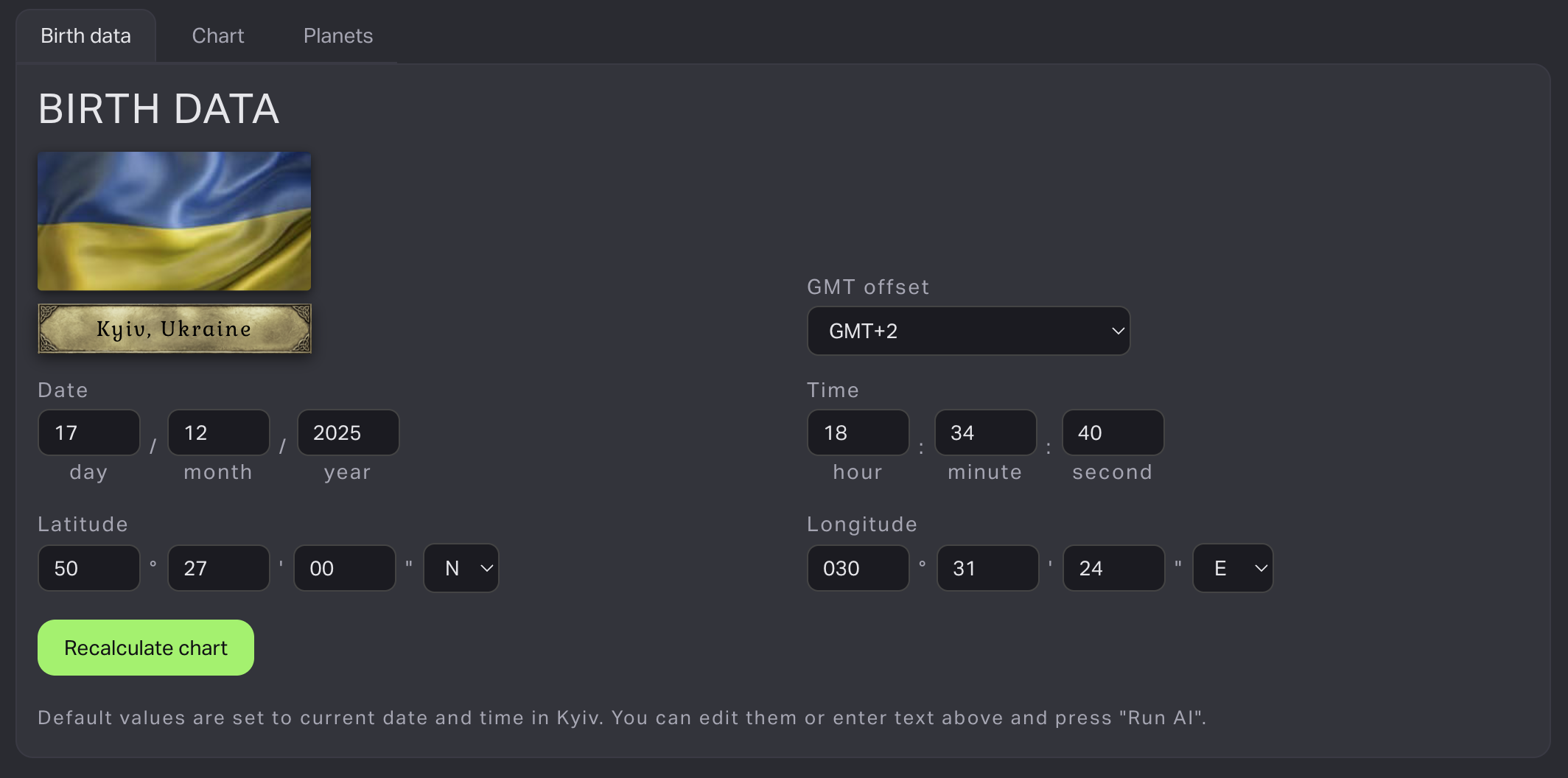
- Enter your birth data in the search for the AI. If you do not know your birth time, enter midday or midnight: later I will explain what to do when the birth time is unknown.

- Check the data after the AI processes it. It is not a problem if you do not know your Greenwich offset or the latitude/longitude of your birthplace. The important thing is not to end up on another continent. AI likes to misbehave when a place name is misspelled. If everything looks roughly like what you entered, press the "Recalculate chart" button.
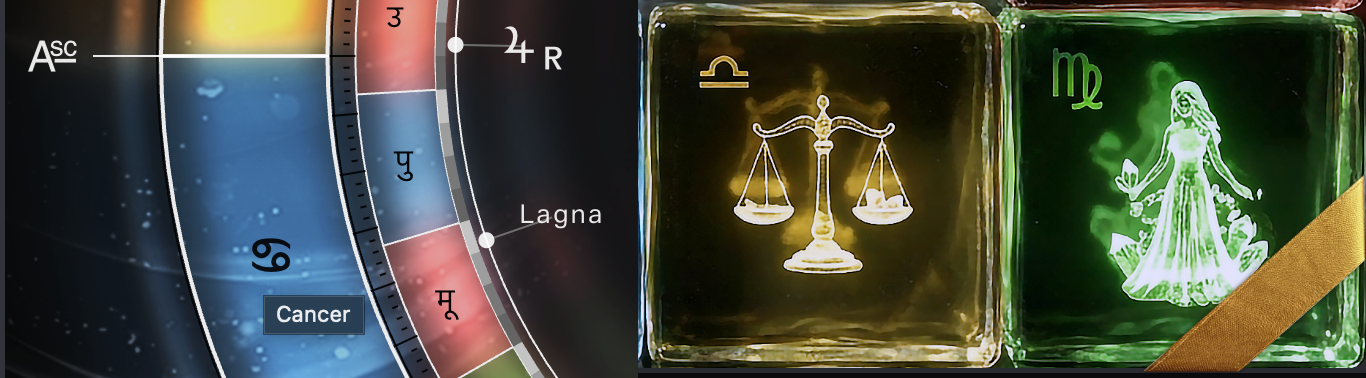
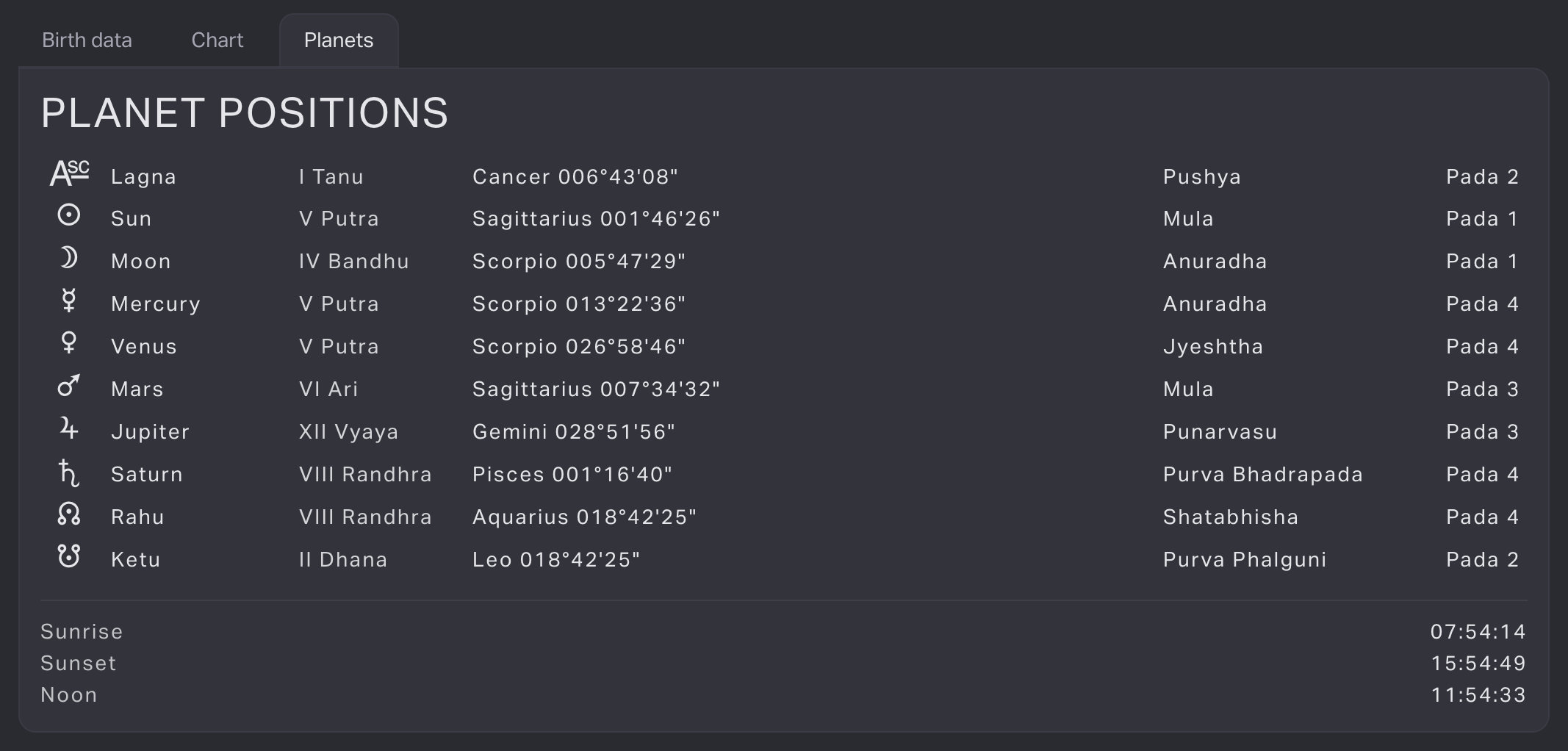
- When the chart opens automatically, you should look at which constellation occupies your first house. This is the sector that contains a point labeled “Lagna” or a square with a yellow ribbon. Or open the "Planets" tab, and on the first line you will see the zodiac constellation of your first house. Remember it.
- If the birth time is unknown, look for the zodiac name of the Moon and remember it. Do not worry that the Moon is not in the first house in the calculated chart. In Jyotish, the chart does not always begin from the Ascendant or Lagna. Jyotish looks at the chart more broadly, and any planet can become the starting point. The Moon is a very important factor in Jyotish: it experiences the influence of events on par with Lagna. The symbolism will be a bit harder to read, but the event correlations will still be there.
You can use any astrological calculator (not necessarily mine) to compute Lagna, just set the sidereal zodiac instead of the tropical one in the settings.
If you did it (and it should not have been hard), you now know two factors about yourself: the position of the Sun in your chart and the position of Lagna - even if, in your case, you had to use the Moon instead of the Ascendant.
But if you are familiar with the Eastern horoscope with the Rat, Tiger and Dragon, then you also know your Eastern zodiac sign. And that means two more positions: the positions of Saturn and Jupiter. (Maybe later I will add a way to determine the zodiac in that Eastern horoscope system too.)
When you listen to a yearly forecast for your Eastern zodiac sign, it is a forecast of global events in your life. That is because Saturn and Jupiter are very slow planets. Jupiter usually stays in one constellation for a year, and Saturn for 2-3 years. But to compose such a horoscope you still need an astrologer, although many astrologers publish such forecasts for free. I think it is not a problem if you do not do that yourself and leave it to a professional.
In astrology there is the concept of a stellium - a cluster of three planets: the Sun, Mercury and Venus. This trio is what we need for personal forecasting. Venus and Mercury do not move far from the Sun, and this property is exactly what we will use to make personal forecasts without astrologers, using a simplified scheme.
Astrology is closer to the art of interpretation than to a mechanical table of meanings. Simply put, each person on Earth lives a certain story with a one-year rhythm. The start of this story is the moment the stellium (three planets: Sun, Mercury and Venus) enters the 1st house - the constellation where your Lagna is (Moon or Ascendant). And the personal story ends in the 12th house, in the constellation that precedes your Lagna.
Let us do it step by step and with an example.
Say you want to find a good job or get a promotion. For career you need the activation of the 10th house, and for a new job you need the activation of the 1st house.
Say your Lagna (or Moon) is in the constellation of Leo. Then Leo will always start a new story, and the constellation before Leo - Cancer - will end the story.
For looking for a new job, for everyone with Lagna in Leo, the time will be from August 14 to September 13.
For a promotion, you need to count ten constellations from Leo. Leo is the 1st house, Virgo is the 2nd, Libra is the 3rd, Scorpio is the 4th, Sagittarius is the 5th, Capricorn is the 6th, Aquarius is the 7th, Pisces is the 8th, Aries is the 9th, Taurus is the 10th - the house we need. That means for career we choose the period from May 14 to June 13.
To prepare for crises, we need to look at the 8th house. That means it will be Pisces if Lagna is in Leo. From March 14 to April 13, everyone with Lagna in Leo should be more careful.
Or you can search for: Hart deFouw, Robert Svoboda - "Light on Life: An Introduction to the Astrology of India". Somewhere there may also be descriptions of Jyotish houses on a website.
Some nuances.
This simplification method does not account for Mars and the lunar nodes - three factors out of ten in Jyotish. But agree: 70% is better than only knowing a character description based on the tropical zodiac, which is about 10%.
Second: the stellium (Sun, Mercury and Venus) can begin an event one month earlier or one month later. Usually they stay close to the Sun, but differences still happen. So it is better to take a slightly wider margin than what I indicated above.
The idea is that to start something, we first think about it. And in thoughts we "run ahead" of the event. Mercury is responsible for this behavior: it runs ahead of the Sun, as if scouting.
Or the opposite: the event is already happening, and we try to catch up with it or run away from it, because we did not think it through in advance. In that case Venus breaks ahead and shows you the future event.
And the middle case is when thoughts and actions move together: then Mercury and Venus stay close to the Sun.
When the birth time is unknown and we use the Moon position as Lagna, there are some nuances too. Usually the chart where the Moon is taken as the starting point is used for analyzing and forecasting children. In books there is no strict age when a person becomes an adult versus still being a child.
From experience I can tell you this: if in your life your mother (or another relative) occupies the main place, you obey that relative and do only what you are told, then for such people the chart from the Ascendant may not work at all, even if you know your birth time. In Italy and Israel, traditionally the mother occupies the central place in a man's life, so for such family traditions it is better to use the Moon chart as the base right away.
The difference in interpretations will depend on the mood and attitude of the relative who influences your life. In such a case events may happen with some delay or start earlier - because your mother warned you not to do it, or your mother told you how to do it right, but you did not listen.
If you are an orphan and the birth time is unknown, you should rely on your inner sense. For example, sometimes an event is already happening, but you cannot believe it yet, you do not feel it yet. That means the event has not reached the Moon chart for you yet. The event exists everywhere, but it does not affect you personally yet. Observe this delay in your life, and you will roughly understand what to expect and when. In general, it is useful for everyone to look at the Moon chart: it shows how you react to events.