HIDDEN WORLD
Astrology Without the Astrologer
E-book with 50% discount
20.00

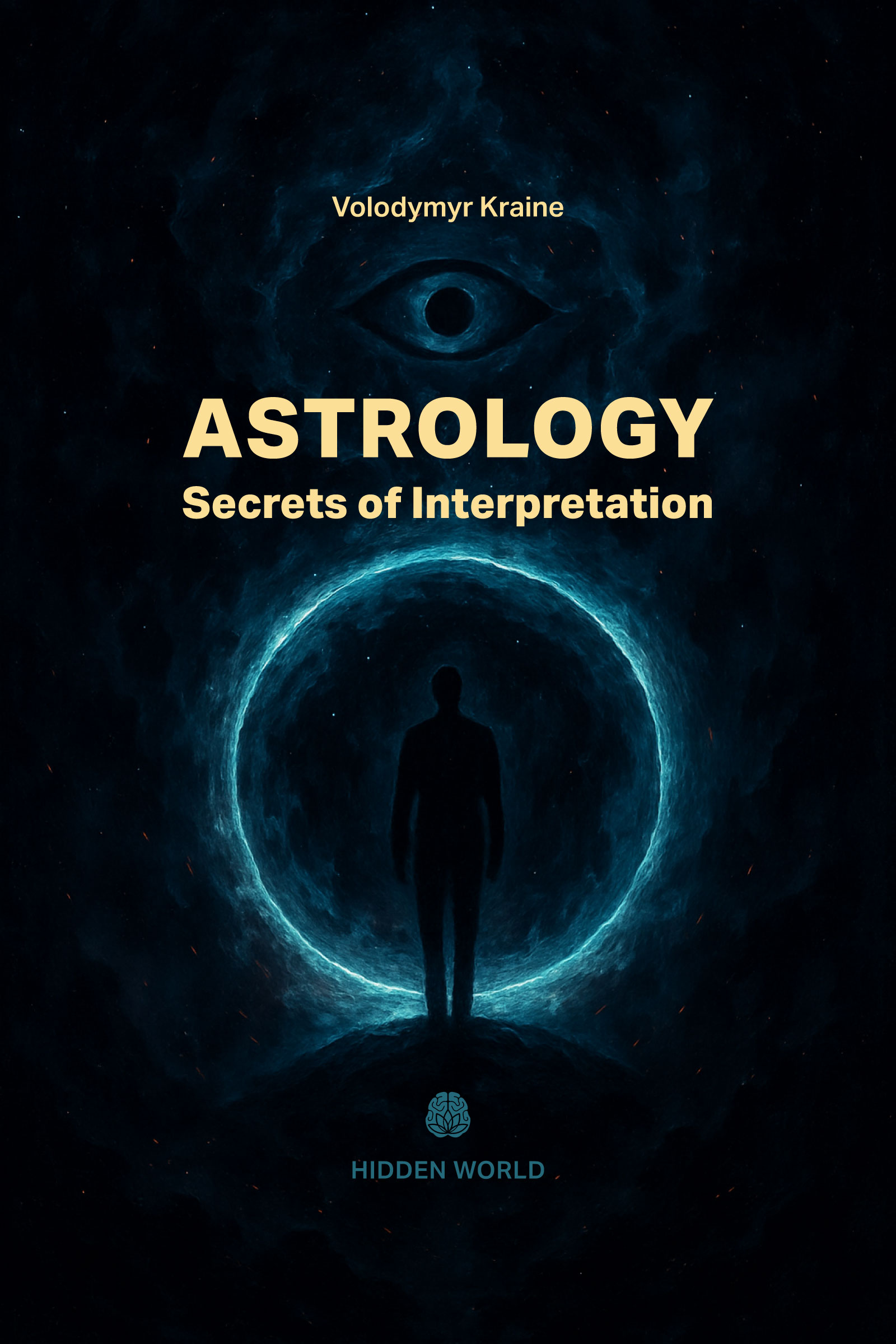
Astrology Without the Astrologer

Volodymyr Kraine

“Astrology Without the Astrologer” is the second edition of a Jyotish book for beginners. It is written for readers who no longer want to look at astrology as someone else’s closed language.

After reading it, you will no longer listen to a Jyotish astrologer blindly. You get a grounded understanding of how Vedic astrology works, what the natal chart actually shows, and why astrological reading forms a system rather than a stream of vague phrases. The book changes the angle from which you look at time, choice, symbol, and event without forcing a false split between astrology and the scientific picture of the world.

The book helps you:

  • understand what Jyotish is and what holds its internal logic together
  • see the structure of the natal chart and its main astrological elements
  • begin to understand what an astrologer is talking about when reading a chart
  • approach astroforecasting with a more coherent foundation

It is a good fit if you:

  • want to enter Jyotish from zero
  • are interested in Vedic astrology but do not want to depend only on other people’s interpretations
  • are looking for a book that gives you a working foundation, not just a stream of terms

If you want to feel the general movement of the author’s thinking first, start with the article “Astrology without an astrologer”.

Format: PDF / EPUB

By purchasing this edition, you support the Hidden World project and the continuation of our research.

Contents

  • Author’s Note
  • Chapter One. Intuition.
  • Chapter Two. Choice
  • Chapter Three. Time
  • Chapter Four. Consciousness
  • Chapter Five. What Is Astrology?
  • Chapter Six. Eight Laws of Art
  • Chapter Seven. Prophecies.
  • Chapter Eight. The Golden Ratio
  • Chapter Nine. How the Astrological Forecast Works
  • Chapter Ten. Astrological Houses
  • Chapter Eleven. The Symbolism of the Astrological Houses
  • Chapter Twelve. Planets and Houses
  • Chapter Thirteen. Tarot and Astrology Together
  • Chapter Fourteen. The Zodiac
  • Chapter Fifteen. The Influence of Planets
  • Chapter Sixteen. Malefics and Benefics
  • Chapter Seventeen. Differences Between Zodiacs
  • Chapter Eighteen. Preparation for Interpretation
  • Chapter Nineteen. First Steps
  • Chapter Twenty. Lagnoscope
  • Chapter Twenty-One. Interpretation of the Lagnoscope
  • Conclusion

Author's Note

“If you can't explain it simply, you don't understand it well enough”

Albert Einstein

This book is intended for the widest possible audience — from beginners to my fellow practitioners.

In it, I briefly explain and demonstrate how astrological symbolism works — and beyond that, how symbolism as a whole operates.

You will not find complex terminology or lengthy philosophical explanations here.

After reading this book, you will be able to interpret any form of symbolism, whatever its nature may be.

It will provide you with a solid foundation for studying or refining your ability to translate the language of symbols.

Chapter One. Intuition.

Usually, intuition consists of three layers:

  • Innate mechanisms: for example, alertness to sudden movements, loud sounds, aggressive faces, rejection, pain.
  • Early experience: from childhood, the brain accumulates thousands of recurring situations and begins to recognize them automatically, without verbal analysis.
  • Unconscious processing: you haven’t yet had time to explain it logically, but the brain has already matched details with past experience and produced a feeling: “something is off here” or “this can be trusted.”

First, let’s look only at innate or genetic mechanisms of intuition.

You are facing a complex life situation. You have several options to choose from, but each of them is risky. The natural desire is to choose something, because humans are given freedom of choice. And here the main problem arises: how do you choose the best option if the consequences are unknown? Nature has its own answer to this question — evolution. Choose wrong — the species dies. Choose right — the species survives, and that choice is fixed in the genes.

That’s where the fear of spiders and the love for cats come from. Spiders are often venomous, so it’s better to stay away from them. Cats, on the other hand, need to be observed: our ancestors were stalked by wild predators, and those who could carefully watch predatory cats survived, reinforcing this observation at the genetic level.

Another layer of information necessary for intuition is knowledge formed in childhood, the so-called stable associations. For some, dogs are loyal friends you can always rely on. But if a dog bites you in childhood, then from that point on all dogs will be associated with danger and pain. That means information about dogs as a symbol of danger will appear in the child’s genes. And that person’s children will already receive a genetic improvement or deterioration, depending on how you look at it. In any case, such information is meant to help the species survive.

So, in order to choose the optimal path, you need to listen to your genes. The problem is, we don’t know how to talk to them in the usual way. But we do know that there is a certain mysterious force — intuition — that helps us make decisions. It is unconscious processing of information — genetic information.

To use it, you need to create an image in your mind and wait a bit. If a similar situation is encoded in your genes — you will “feel” the answer.

This method is, to put it mildly, not the most reliable. But how else could nature implement genetic communication? More than 80 billion neurons in the brain and 30–40 trillion cells in the body — this is a colossal data set that cannot be fully processed. Simply put, our DNA is a gigantic book, and each gene is a separate page. Each cell nucleus stores such a page, many of which are repeated. Reading the entire book is impossible. That’s why the mechanism of intuition is more of an attempt to guess the result than to reproduce it precisely.

And so, when using intuition, another problem arises: how do you tell whether it’s intuition or just your expectation of the outcome? This is where divination systems based on visual imagery come in. There are quite a few of them — here are some examples:

  • divination on coffee grounds, tea, or wine
  • divination by smoke or ashes
  • divination using wax or lead
  • divination by clouds and celestial images
  • divination by reflections and water waves
  • divination by flame
  • lithomantic and sand practices
  • perceiving random images

Our brain fills in about two-thirds of the information it receives, and if you focus on finding an intuitive solution, it begins to see familiar patterns even in random forms. Scientists are absolutely right: in these patterns, you can see almost anything. For materialistic science, this is not proof of divination, but for esotericists, it is. Not everyone needs an explanation of the principles; more often, people just need a working method.

Examples of this principle in everyday life are obvious:

  • You want to buy something — and suddenly you see it everywhere, as if the universe itself is signaling: “Here it is, take it.”
  • If you are anxious, the world will show only bad news: police cars, fire trucks, ambulances.
  • If you are in love, the whole world seems like a fairy tale: everything is sweet, and gloomy people and bad things seem to vanish.

Now let’s delve into the understanding of symbolism. The situation is the same: you need to make a choice, but the consequences are unknown. Sometimes, you do not want to rely on your own intuition. Then you seek advice from the outside. From the outside, the situation looks different: an external observer does not feel your stress, and their view is not clouded by expectations.

A modern person often tries to manage without esotericism and goes to experts. Don’t know whether to plant potatoes or tomatoes — you go to farmers. Want to choose tiles for the kitchen — you go to tile installers. Experiencing inner distress — you go to psychologists. And only when all the experts in the world cannot help, do people turn to esotericists.

An esotericist applies their methods to answer your questions. In the case of divination based on images, it is important that the diviner resonates with your question — as if addressing their own genes with your query. This is an extremely subjective and complex process. The diviner must empathize with you and understand the essence of the question. If there is no empathic connection, the answer will be weak or distorted. An observant person can even tell, from the answers of some diviners, what troubles them personally.

To solve this problem, ancient diviners began observing nature. They noticed that nature reflects the essence of phenomena through synchronicity. Many esotericists build their work on this idea: dozens of books about synchronicity, archetypes of the psyche, God, and the Universe. I will not repeat their content — after reading these books, clarity rarely increases. I will present the essence more briefly and clearly, saving your precious time.